

▸Table of Contents
- 1The Number Being Compared Is the Wrong Number
- 2What Really Changes Between the Two
- 3Spirits Punish a Bottle That Reacts
- 4Where Plastic Is Simply the Better Tool
- 5Six Cost Lines That Decide the Answer
- 6What the Maths Looks Like on 20,000 Units
- 7The Bottle Is Part of the Product
- 8A Matrix to Shortcut the First Conversation
- 9FAQ
- 10What to Do Before the Next Quote Review
Two quotes land on the desk. One glass bottle, one PET, and one is cheaper. Most of the time the decision gets made right there, on the lower number. That number is real. It is also incomplete in three specific ways, and the gap between the quote and the invoice is where packaging budgets quietly go wrong.
The Number Being Compared Is the Wrong Number
A bottle price is not a cost. It is a starting point that ignores weight, container loading and handling damage. Change any of those and the ranking moves, sometimes far enough to reverse it.
A bottle quoted at half price can land cheaper than the alternative, or noticeably dearer, depending on how far it travels and what sits inside it. Neither bottle changed, which tells you the unit price never carried the answer. What matters instead is the cost of a filled, shipped, sellable unit, and that number has to be assembled line by line.
What Really Changes Between the Two
Most of the difference sits in a handful of properties. The rest is sales material.
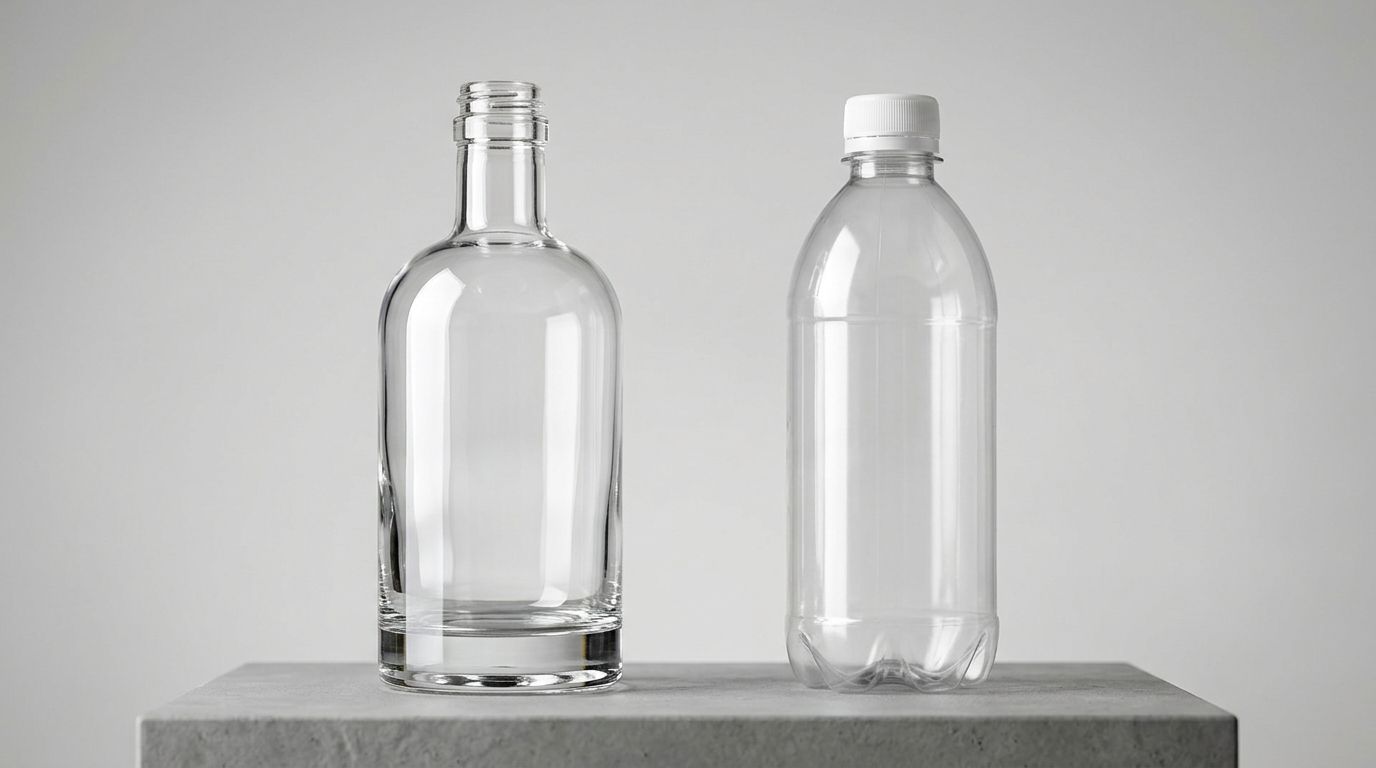
glass vs plastic bottle comparison – glass bottle and PET bottle side by side
The two containers above hold the same volume. They do not weigh the same, and that single fact runs through every line of the cost model that follows.
| Property | Glass | PET | What it changes |
|---|---|---|---|
| Chemical inertness | No reaction with contents | Can interact with some contents | Flavour drift, compliance exposure |
| Migration | None into product | Additive migration is regulated | Testing cost and market access |
| Oxygen barrier | Very high | Moderate, often needs help | Shelf life of spirits and juice |
| Weight, 500 ml | Roughly 300 g | Roughly 25 g | Freight cost and loading rate |
| Impact | Breaks, fragments stay contained | Flexes and survives drops | Breakage rate, outdoor use |
| Heat | High, suits hot fill | Limited, deforms | Filling process choice |
| Recycling | Widely recycled, can be refilled | Recycled, often down-cycled | Brand claims, regulation |
Weight and barrier do most of the work. Everything else waits until a compliance officer or a filling line asks a question, and that is usually later than you would like.
Spirits Punish a Bottle That Reacts
Ethanol is a solvent, and a forty percent spirit is not opened the week it is bottled. A year in a warehouse followed by six months behind a bar gives any chemical interaction all the time it needs.
Glass does not take part in that conversation. The spirit changes through oak, through the closure, through time, but not through the wall. That is what inert means in practice, and it is why high-ABV products rarely move to plastic.
Oxygen is the quieter problem. Barrier performance decides whether a delicate flavour still tastes right at month twelve. A PET bottle alternative can reach acceptable barrier with coatings or scavengers, though the added layers bring cost and a fresh round of qualification testing.
Refill loops are the third factor, and they apply only to certain channels. Dairies, water routes and on-premise accounts wash and reuse heavy glass many times over. Once a bottle enters that cycle it behaves like equipment rather than packaging, so cost per fill keeps falling.
Where Plastic Is Simply the Better Tool
At a festival, a stadium or a station kiosk, a shattered bottle is an incident report before it is a lost sale. PET bends, survives the drop, keeps the queue moving.
Restocking rhythm matters just as much. Lighter bottles mean more units per pallet and fewer strained backs on a route with twenty stops, so the advantage builds across many small deliveries instead of one large one.
Worth adding a warning here. Low weight only pays when the bottle arrives intact. Thin-wall PET at the bottom of the market leaks at the finish and cracks in the cold, which moves the breakage problem somewhere else rather than deleting it.
Six Cost Lines That Decide the Answer
Build the model on six lines. Leave one out and the answer usually flips.
| Cost line | What belongs in it | Where buyers go wrong |
|---|---|---|
| Unit price | Bottle, closure, decoration | Comparing bare bottle to decorated bottle |
| Inbound freight | Freight per container, all in | Using cost per kilogram instead of per unit |
| Loading rate | Units per container at the real cap | Assuming volume limit equals weight limit |
| Breakage and loss | Rate times replacement cost | Forgetting freight on the replacement units |
| Secondary packaging | Dividers, layer pads, shrink wrap | Overlooking that glass needs more protection |
| Claims and returns | Leakage, breakage, customer credits | Treating these as one-off events |
Loading rate is where most models break. Glass is dense enough that a 40ft container often hits the weight cap with floor space to spare, while PET hits the volume cap instead. Two different limits mean freight per unit cannot be scaled from weight alone. You need real units per container, taken from the actual pack spec.
What the Maths Looks Like on 20,000 Units
Round numbers, used to show the method. Not a quotation.
| Line | Glass, 500 ml | PET, 500 ml |
|---|---|---|
| Unit price | 0.30 | 0.12 |
| Units per 40ft container | 20,000 | 32,000 |
| Freight per container | 2,600 | 2,600 |
| Freight per unit | 0.130 | 0.081 |
| Breakage allowance | 0.015 | 0.002 |
| Secondary packaging per unit | 0.020 | 0.006 |
| Indicative landed cost | 0.465 | 0.209 |
Look at the last row for a moment. Under these assumptions glass lands about 0.26 higher per unit. On a water bottle selling below one currency unit, that gap absorbs most of the margin. On a spirit selling at forty-five, the same 0.26 is a fraction of one percent.
Identical gap, opposite conclusion. The material did not change. The retail price did.
The Bottle Is Part of the Product
A heavy base settles onto a bar top and makes a sound people recognise. A crisp shoulder catches light before anyone reads the label. None of that shows up on a cost sheet, and all of it moves the sale.
Reuse carries the effect further. Buyers keep good bottles and put them back to work at home, so the brand stays visible years after the last pour. Thin plastic rarely gets that second act.
Glass bottle packaging therefore sits in two budgets at once. Judge it only as a cost line and you tend to get a cheaper bottle and a weaker product. Our breakdown of glass vs plastic bottles for liquor follows the premium argument further.
A Matrix to Shortcut the First Conversation
| Scenario | Default choice | Main reason |
|---|---|---|
| Spirits above 30 percent ABV, long shelf life | Glass | Inert, no migration, strong barrier |
| Premium gift box and limited edition | Glass | Perceived value and secondary use |
| Outdoor, sports and travel channels | PET | Impact resistance and low weight |
| Low-priced still water, long runs | PET or lightweight glass | Cost sensitivity per unit |
| Hot-fill juice and pasteurised products | Glass | Heat resistance, no deformation |
| Beer and oxygen-sensitive drinks | Glass | Flavour protection over months |
Three questions usually settle it before the model is even needed. What temperature does your filler run at? How long must the product last on shelf? What retail price does the pack have to fit inside? Answer those and the material tends to pick itself.
FAQ
Is glass always more expensive at landed cost?
Per unit, usually. However, the gap narrows sharply once PET needs barrier layers, and it widens once breakage and returns are counted honestly.
How do I compare freight fairly across two materials?
Convert to cost per unit at the real loading rate. Avoid cost per kilogram, because the two materials bind on different container limits and the comparison drifts.
Does packaging weight change sustainability claims?
It can, in both directions. Lighter packaging lowers transport emissions, while reusable glass lowers total material demand. Either claim holds up when it rests on the right number.
What to Do Before the Next Quote Review
A material decision is a commercial one, and a good version of it rests on more than a price. Weight sets freight and barrier limits shelf life, while damage patterns supply the surprises that never made it into the budget.
Model it once and the argument changes character. Products that are premium, long-lived or heat-filled tend to justify glass. Products that are light, short-lived and price-driven often suit a PET bottle alternative. Wherever the answer lands, it rests on landed cost packaging arithmetic rather than a debate about unit price.
If you want to run glass on your own line, our note on glass bottle mold cost covers the one-time tooling side, and our glass bottle inspection process explains how a lot is released before it ships.
Need Packaging Advice or a Quote?
Talk to our glass packaging experts — on time and on budget.


