

▸Table of Contents
- 1Why Glass Bottle Quality Control Has to Start at the Hot End
- 2Stage 1: Hot End Forming Monitoring, Inspection in Real Time
- 3Stage 2: The 8-Hour Cold End Deep Re-Inspection
- 4The Seven Cold End Checks at a Glance
- 5Stage 3: Pre-Shipment Final Audit and AQL Release
- 6Why Three Stages Beat One Final Inspection
- 7What This Means for Your Filling Line
- 8FAQ
- 9Conclusion
High pass rates are never an accident. In fact, they are the result of a glass bottle quality control system that catches problems long before the container reaches your filling line. Therefore, we built a three-stage defense that runs from the moment a bottle leaves the mold to the moment a pallet is released for shipment. Moreover, each stage has its own timing, its own equipment, and its own release rule. Consequently, defects are stopped at the source instead of being sorted out at the very end.
Why Glass Bottle Quality Control Has to Start at the Hot End
Glass forming is a race against temperature. Specifically, a gob is shaped at roughly 580 to 620 degrees Celsius, and the bottle begins to set within seconds. Therefore, any fault that appears in that short window is copied across thousands of containers until someone corrects it. However, a single final inspection cannot undo that damage, because it only sorts bad bottles out after the loss has already happened. For this reason, our process begins at the forming station, not in the warehouse. The tooling itself matters as much as the machine, which is why we explain the economics behind glass bottle mold cost for buyers who are still at the design stage.
Stage 1: Hot End Forming Monitoring, Inspection in Real Time
The first defense is inspection at the moment of birth. As soon as a bottle leaves the mold, it enters a quality tracking loop. Furthermore, our technicians patrol the forming area every two hours, and each patrol is a structured check rather than a quick glance.
During each patrol we review gob weight and distribution, mold temperature stability, shoulder and body formation, finish shape, and any visible defect such as folds, cracks, or off-shape necks. In addition, we log the forming state and compare it with the previous patrol record. In this way, small drift is caught before it becomes a trend.
When a trend does appear, we adjust the machine settings or the mold condition immediately. Subsequently, the correction is verified on the next patrol, so we know the change worked. As a result, batch defects are controlled at the source rather than discovered weeks later in a customer warehouse.
Stage 2: The 8-Hour Cold End Deep Re-Inspection
The second defense is a deeper look, and it happens fast. After the bottle leaves the annealing lehr, which typically runs between 520 and 550 degrees Celsius, the glass needs time to cool and settle. Meanwhile, we schedule the second full inspection within eight hours of annealing, so the container is tested in a stable state.
Cold end inspection relies on two sets of eyes. On the one hand, optical automatic inspection machines scan every bottle at line speed for dimensional and visual faults. On the other hand, experienced inspectors perform manual light inspection, holding each bottle against a bright light box to catch bubbles, stones, cracks and thin spots that a camera can miss.
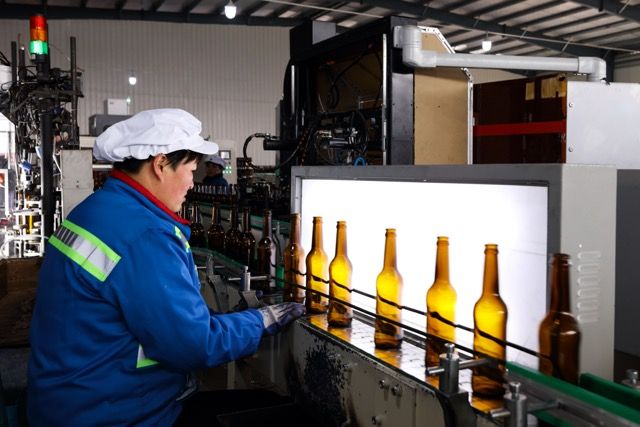
glass bottle inspection process – manual light inspection at the cold end
Therefore, the machine handles volume and repeatability, while the human eye handles judgment and edge cases. Together they close the gap that either method leaves alone. For buyers who want the wider production picture, our glass beer bottle production guide covers how these checks connect to the whole line.
The Seven Cold End Checks at a Glance
Within that eight-hour window we run seven checks, and each one maps to a specific failure mode.
| No. | Check | What we measure | Why it matters |
|---|---|---|---|
| 1 | Wall thickness distribution | Minimum and maximum wall on body, shoulder and base | Thin spots weaken the bottle and raise burst risk |
| 2 | Verticality | Lean of the body against the base | Poor verticality causes jams and capper misalignment |
| 3 | Finish dimensions | Thread, bore, height and sealing surface | Loose or tight finish breaks cap and cork sealing |
| 4 | Capacity and fill point | Actual volume and fill height | Wrong capacity leads to short fills or overflow |
| 5 | Annealing stress | Residual stress after cooling | High stress means cracks and thermal shock failures |
| 6 | Optical and visual defects | Bubbles, stones, cracks, folds, seeds | These are the defects buyers reject first |
| 7 | Thermal shock and impact | Resistance to temperature change and impact | Confirms the bottle survives filling and transport |
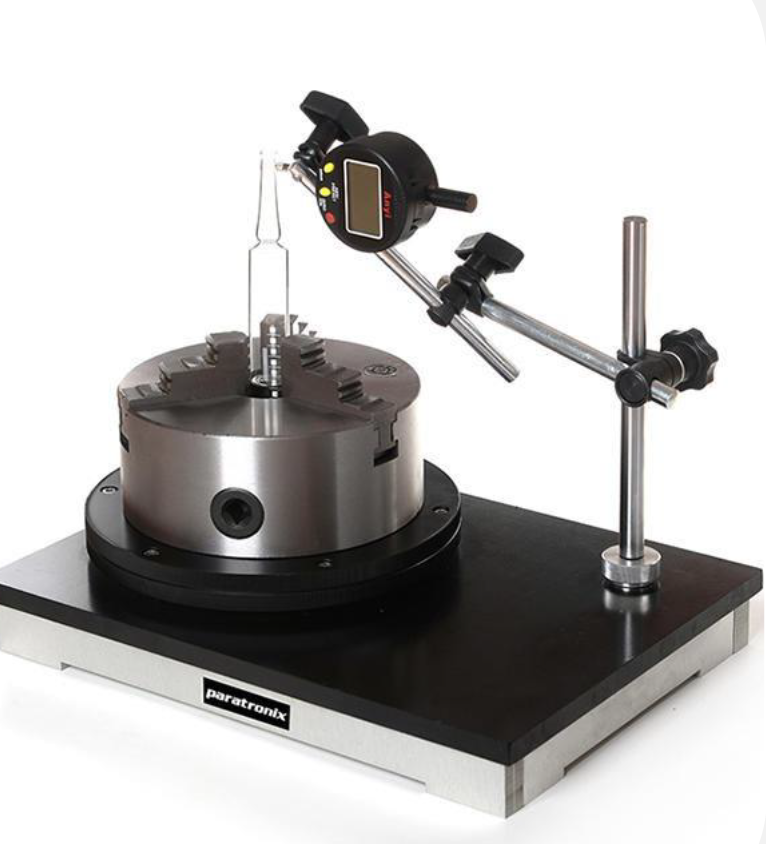
The verticality check above uses a rotating chuck with a digital gauge touching the body wall. As the bottle turns, the gauge reads the runout of the axis. If the value exceeds the drawing tolerance, the bottle would jam in a capper or lean in a case packer, so it is rejected at this stage.
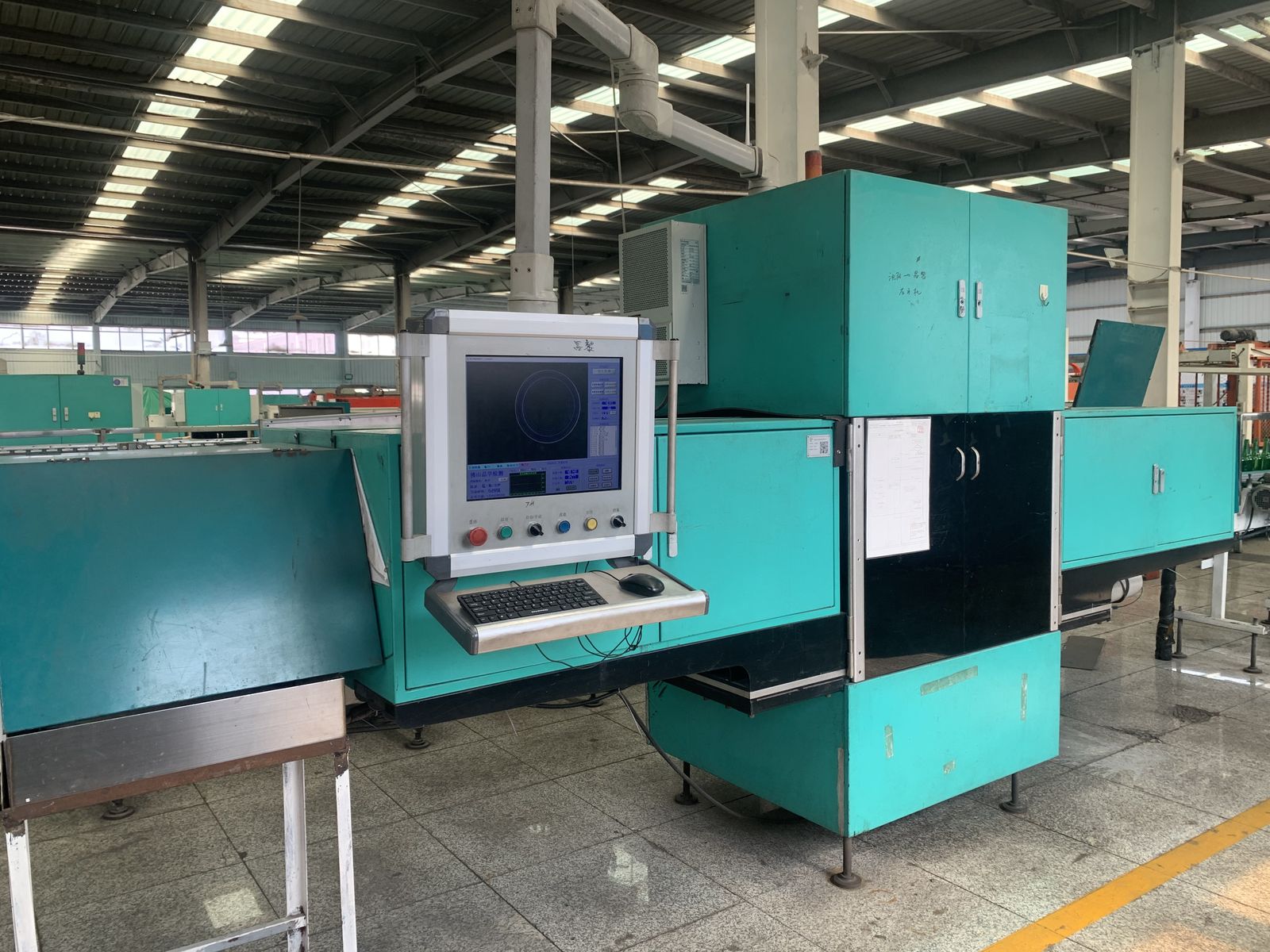
glass bottle quality control – optical automatic inspection machine on the cold end line
Stage 3: Pre-Shipment Final Audit and AQL Release
The third defense is the release gate. Once production is complete, we run a final total quality audit on finished, packed goods. Specifically, we draw a second random sample from cartons that are already packed and ready for the container. Moreover, we re-check all key indicators rather than trusting earlier results.
Only when the sample passes the agreed AQL standard is the pallet released. AQL stands for Acceptance Quality Limit, and it is defined by ISO 2859-1 and its Chinese equivalent GB/T 2828.1. In practice, we classify defects into critical, major and minor, then compare the number of defects found against the acceptance number for that lot size.
| Defect class | Typical definition | Typical acceptance |
|---|---|---|
| Critical | Leakage, sharp edges, safety risk | Zero tolerance |
| Major | Cracks, wrong finish, heavy distortion | Very low acceptance number |
| Minor | Light scratches, minor color shift | Higher acceptance number |
For example, on a lot of 5,000 bottles at general inspection level II, the sample size is 200 bottles. At AQL 2.5 the acceptance number is 10 and the rejection number is 11. However, the exact plan depends on the contract, so we always confirm it with the buyer before the audit. As a result, both sides judge the shipment by the same rule.
Why Three Stages Beat One Final Inspection
A single final check feels cheaper, but it is also weaker. In contrast, three stages separate the causes of defects instead of only counting their results.
| Approach | When defects are caught | Typical outcome |
|---|---|---|
| One final inspection | Only at the end, after losses are made | High cull rate, late surprises, rework |
| Three-stage system | At forming, after annealing, and before shipment | Stable pass rate, predictable delivery |
What This Means for Your Filling Line
Consistent quality changes your daily operation, not just your incoming report. For example, a bottle with even wall thickness and low residual stress runs through a high-speed line without sudden bursts. Furthermore, a controlled finish keeps capping torque stable, so your capper does not need constant adjustment. Meanwhile, a clean release audit means fewer surprises when the container is opened.
In addition, a stable pass rate protects your schedule. Because you spend less time clearing glass fragments and restarting the line, your production plan holds. Therefore, the value of quality control shows up as uptime, not only as a certificate. If you are still comparing suppliers, our guide on how to choose the right glass bottle manufacturer covers the questions worth asking.
FAQ
What is the difference between hot end and cold end inspection?
Hot end inspection happens at the forming station, where technicians patrol every two hours and correct the process. Cold end inspection happens within eight hours of annealing, using optical machines and manual light inspection.
Can I review the inspection records before shipment?
Yes. We keep daily inspection reports with measured dimensions, defect photos and test results, and these records can be shared during the pre-shipment audit.
How do you apply AQL on my order?
We agree the defect classes, the inspection level and the AQL values in the contract. Afterwards, the final audit follows that plan, and the pallet is released only when the sample passes.
Conclusion
Reliable shipments do not come from a lucky batch. Instead, they come from a glass bottle quality control system that checks at the right moment, with the right tool, and releases against a clear rule. Consequently, the three stages work as one loop, and each stage protects the next. If you want to see how this applies to your own bottle, our team can walk you through the inspection plan for your next order, from forming to the final AQL audit.
Need Packaging Advice or a Quote?
Talk to our glass packaging experts — on time and on budget.


