

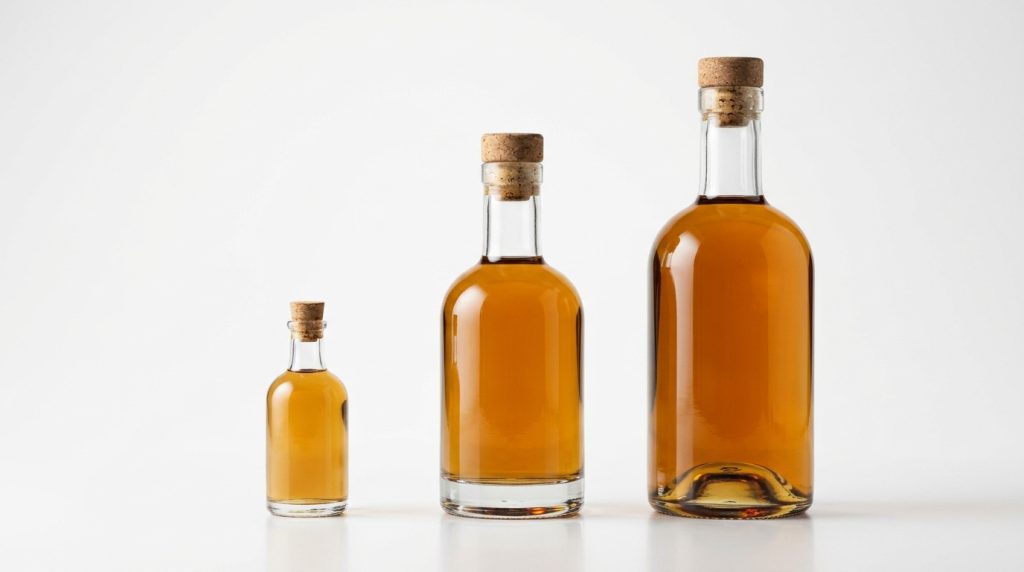
Picking the wrong packaging formats for your agave spirit will kill your margins before the pallets even hit the distributor’s warehouse. You need to understand how specific tequila bottle sizes directly dictate your shipping costs, retail placement, and ultimate brand perception.
The Strategic Impact of tequila bottle sizes
Why Dimensions Dictate Profitability (tequila bottle sizes)
Consequently, the physical footprint of your glass liquor bottles shapes your entire logistics chain from the factory to the end consumer. Every millimeter added to the diameter or height reduces the number of units you can fit on a standard pallet. Furthermore, inefficient packing translates to bloated freight expenses, which eat directly into your bottom line.
Retail Shelf Constraints (tequila bottle sizes)
Specifically, retailers are notoriously strict about the height and width of the alcohol bottle sizes they choose to stock. If your bottle is too tall, it gets relegated to the top shelf where visibility plummets, or the bottom shelf where it is perceived as a cheap commodity. Therefore, aligning your dimensions with standard retail shelving is non-negotiable for new agave brands seeking rapid market penetration.
The Psychology of Proportion (tequila bottle sizes)
Moreover, the visual weight of alcohol bottles communicates the spirit’s value before the cork is ever popped. If you are looking for a foundational overview, check out our complete guide to tequila bottle sizes. A short, stout bottle implies artisanal craftsmanship, while a tall, slender silhouette suggests modern elegance. Consequently, selecting the appropriate shape for your chosen volume is critical to align with your brand’s core identity.
Breaking Down Standard Alcohol Bottle Sizes
The 50ml Format (Miniatures)
Initially, many brands dismiss the 50ml format as a novelty or an afterthought. However, these miniature alcohol bottles act as powerful sampling tools in the highly competitive agave spirit industry. Consumers hesitate to drop $60 on an unproven craft tequila, but they will gladly spend $5 to taste it.
Logistics of 50ml Miniatures
Accordingly, shipping 50ml glass liquor bottles requires specialized, high-density case packing to prevent breakage during transit. For a deep dive into sourcing these formats, review our comprehensive guide to miniature alcohol bottles. Despite the small footprint, the glass-to-liquid weight ratio is exceptionally high in these miniatures. Consequently, freight costs per ounce of liquid are significantly steeper than in larger formats.
The 375ml Format (Half-Bottles)
Meanwhile, the 375ml size occupies a strategic middle ground for many premium agave producers. These tequila bottle sizes appeal to consumers seeking premium agave spirits without the full financial commitment of a standard bottle. Specifically, they work exceptionally well for high-end mezcals, extra añejos, and limited releases where the price per ounce is substantial.
Shelf Presence of 375ml
Furthermore, 375ml alcohol bottles can be exceptionally tricky to merchandise effectively in a retail environment. Because they are shorter, they sometimes get lost on shelves designed specifically for taller formats. Therefore, designing a wider base, a thicker glass bottom, or a more distinctive silhouette is crucial to ensure these glass liquor bottles capture consumer attention.
The Dominance of the 750ml Format
The Industry Standard
Undeniably, according to global reports from the IWSR Drinks Market Analysis, the 750ml format remains the undisputed king of alcohol bottle sizes in the United States market. Nearly all standard bar rails, retail shelves, and back-bar displays are explicitly engineered to accommodate these dimensions. Consequently, launching your core tequila or mezcal in anything other than a 750ml format is a massive logistical risk.
Supply Chain Efficiencies
Moreover, the global supply chain for 750ml glass liquor bottles is incredibly mature, robust, and optimized. You will find the widest variety of stock molds, closures, and corrugated packaging solutions engineered specifically for this size. Therefore, sourcing these alcohol bottles is generally much faster and significantly more cost-effective for a growing brand.
Pallet Optimization for 750ml
Specifically, a standard pallet can efficiently hold a highly predictable number of 750ml cases, usually ranging from 56 to 80 cases depending on the bottle’s weight and shape. Ultimately, this predictability allows for highly accurate freight forecasting and margin analysis. If you are exploring wholesale glass bottles in bulk, optimizing your 750ml pallet configurations is where you will see the most significant long-term cost savings.
The 1L Format for On-Premise Dominance
Built for the Bar Rail
Conversely, the 1L format is practically invisible in standard retail settings but completely dominates the on-premise (bar and restaurant) sector. Bartenders heavily favor 1L tequila bottle sizes because they require significantly fewer bottle changes during a busy service shift. Furthermore, the slightly taller profile often features a longer neck, which is absolutely ideal for a fast, secure grip when pouring rapidly.
Economic Advantages of 1L
Financially, 1L alcohol bottles offer a vastly superior volume-to-glass ratio compared to smaller formats. Consequently, brands can offer bars a much better price per ounce, making it a compelling volume play for well drinks and high-volume cocktails. However, these larger alcohol bottle sizes require robust, reinforced corrugated boxes to handle the significantly increased weight during palletized transit.
Sourcing Strategy for 1L
Therefore, if your agave brand is aggressively targeting on-premise accounts, you must prioritize sourcing incredibly durable 1L glass liquor bottles. Specifically, look for designs with heavily reinforced bases to withstand the severe impact of being repeatedly slammed into bar rails.
The 1.75L “Handle” Format for Volume and Wholesale
Dominating Big Box Retail
Subsequently, when your brand transitions from craft darling to high-volume powerhouse, the 1.75L format becomes essential. These massive tequila bottle sizes are explicitly designed for big-box retailers, wholesale clubs, and heavy-volume consumer consumption. Consequently, they command serious shelf real estate and drastically increase the overall volume moved per transaction.
Ergonomics of Large Bottles
Furthermore, pouring from a 1.75L bottle can be physically challenging for the consumer. Therefore, these oversized alcohol bottles frequently incorporate ergonomic grip features or physical handles molded directly into the glass. Specifically, designing a 1.75L bottle that is easy to pour while maintaining the premium aesthetic of your agave brand is a complex engineering challenge.
Freight Reality of 1.75L
Logistically, shipping 1.75L glass liquor bottles is an entirely different beast. The sheer weight of the liquid combined with the heavy glass creates massive pallets that often “weigh out” a shipping container before it “cubes out.” Consequently, freight calculations for these large alcohol bottle sizes must prioritize weight restrictions over pure volumetric space.
Global Variations: The 700ml Format
The European Standard
Meanwhile, if your agave brand harbors international ambitions, you must intimately understand the 700ml format. In the European Union and the United Kingdom, 700ml is the legally mandated standard for tequila bottle sizes, completely replacing the American 750ml. Therefore, trying to export 750ml bottles to Europe is not just inefficient; it is often entirely illegal.
Dual-Sourcing Challenges
Consequently, managing a global brand requires dual-sourcing similar glass liquor bottles in both 750ml and 700ml capacities. This severely complicates your supply chain, requiring parallel inventories of glass, labels, and outer cartons. Specifically, working with a manufacturer who can produce visually identical alcohol bottles in both capacities is critical for global brand consistency.
Tooling and Mold Costs
Furthermore, developing custom molds for both 750ml and 700ml alcohol bottle sizes requires double the initial capital expenditure. However, failing to invest in the correct European format will completely lock your agave spirit out of highly lucrative international markets. Therefore, baking the cost of 700ml glass liquor bottles into your long-term expansion budget is absolutely essential.
Material Considerations for Glass Liquor Bottles
Flint vs. Super Flint Glass
When selecting your tequila bottle sizes, the intrinsic quality of the glass itself is equally as important as the dimensions. Specifically, standard flint glass is adequate for entry-level spirits, but premium agave brands require high-clarity super flint glass. Furthermore, super flint offers exceptional transparency, making the liquid inside appear significantly more brilliant and enticing to the consumer.
Weight and Premium Perception
Additionally, the physical weight of the glass liquor bottles heavily influences consumer perception of value. A heavier base (often called a punt) subconsciously signals a higher-quality, luxury product. However, this extra glass weight directly and aggressively impacts shipping costs, especially for larger alcohol bottle sizes like 750ml and 1.75L.
Balancing Cost and Quality
Consequently, brands must carefully calculate the long-term ROI of utilizing heavier glass. While a massive, thick-bottomed bottle might look fantastic on a shelf, it could easily add 15% to your inbound freight costs from the manufacturer. Therefore, consulting with an experienced manufacturing partner and reviewing our glass bottle manufacturing cost guide is vital to strike the perfect balance between a premium feel and logistical efficiency for your chosen alcohol bottles.
Eco-Friendly Lightweighting
Conversely, modern sustainability trends are pushing brands toward “lightweighting” their glass liquor bottles. Specifically, advanced manufacturing techniques can produce incredibly strong bottles using significantly less glass. Ultimately, this reduces your carbon footprint while simultaneously slashing the freight costs associated with all of your tequila bottle sizes.
Designing for the Agave Spirit Market
Cultural Authenticity
Furthermore, agave spirits carry a rich, deep cultural heritage that absolutely must be reflected in the packaging design, adhering to the strict authenticity standards often promoted by the Consejo Regulador del Tequila (CRT). Discerning buyers expect glass liquor bottles that subtly nod to Mexican tradition without appearing kitschy or cliché. Specifically, integrating textured glass, agave-inspired geometric patterns, or rustic finishes can drastically elevate the presentation.
Neck Finishes and Closures
Simultaneously, the closure system must perfectly complement the chosen liquor bottle sizes. While a heavy, oversized wooden stopper might look excellent on a 750ml bottle, it could completely overpower 50ml alcohol bottles. Consequently, ensuring the neck finish perfectly matches the closure scale is critical to prevent leaks and maintain brand integrity across the portfolio.
Surface Decoration Techniques
Moreover, the physical shape of your glass liquor bottles determines how easily labels, frosting, or screen printing can be applied. A complex, highly faceted bottle might look stunning, but it will significantly slow down a high-speed bottling line. Therefore, if you are utilizing multiple alcohol bottle sizes, ensure the decoration panels are consistent to streamline the application process at the distillery.
Logistics, Freight, and Pallet Optimization
The Tyranny of the Pallet
Ultimately, the humble wooden pallet dictates the financial viability of your entire packaging strategy. Every time you select specific liquor bottle sizes, you are implicitly deciding how much air you are paying to ship. Consequently, optimizing the external dimensions of your glass liquor bottles to maximize pallet density is the highest-leverage activity a supply chain manager can perform.
Container Utilization
Specifically, when importing empty alcohol bottles internationally, you pay for the entire shipping container, regardless of how much glass is inside. If your bottles feature an aggressively wide footprint, you will fit fewer cases per container, drastically driving up the landed cost per unit. Therefore, slightly modifying the shoulder width of your alcohol bottle sizes can save thousands of dollars per shipment.
Breakage and Shrinkage
Furthermore, uniquely shaped glass liquor bottles often suffer from higher breakage rates during transit. Sharp corners or extremely long necks create structural vulnerabilities that standard corrugated dividers struggle to protect. Consequently, balancing an eye-catching design with structural integrity is paramount when finalizing your liquor bottle sizes.
Corrugated Box Engineering
Similarly, the outer master carton must be specifically engineered to support the exact weight and shape of your alcohol bottles. A box designed for standard 750ml bottles will fail catastrophically if used for heavier, custom-molded 1L units. Therefore, treat the corrugated carton as an integral component of your glass liquor bottles procurement process.
Strategic Portfolio Expansion
Scaling from the Core 750ml
Typically, an agave brand will aggressively launch with 750ml glass liquor bottles to establish a solid market presence. Subsequently, once the core product gains sustainable traction, introducing alternative liquor bottle sizes becomes a highly viable strategy to capture entirely new market segments. For instance, launching a 375ml version of your premium añejo can attract buyers intimidated by the full-size price tag.
The Role of Limited Editions
Furthermore, limited edition and ultra-premium releases often utilize entirely unique alcohol bottle sizes to differentiate them from the core lineup. You might use a heavy, custom-molded format to signal extreme exclusivity to collectors. Consequently, these specialty alcohol bottles command a significantly higher price point and generate massive marketing buzz for the brand.
Managing SKU Proliferation
However, managing a diverse, ever-expanding portfolio of glass liquor bottles requires highly sophisticated inventory control systems. Every new size you introduce requires its own specific closures, labels, shippers, and warehouse space. Therefore, aggressively expanding your liquor bottle sizes without sufficient market demand will inevitably lead to costly warehouse bloat and cash flow issues.
Labeling and Decorating Different Alcohol Bottles
Consistent Brand Identity
Maintaining a cohesive brand identity across wildly different liquor bottle sizes is a massive design challenge. A label that looks perfectly balanced on a 750ml bottle will often look cramped and unreadable on 50ml alcohol bottles. Specifically, designers must meticulously scale and adjust the typography and artwork for every single bottle variation.
Application Challenges
Furthermore, automated labeling machines are extremely sensitive to the curvature of glass liquor bottles. If your 375ml format features a drastically different taper than your 1L format, you will suffer from rampant label wrinkling and line downtime. Consequently, keeping the label panel relatively uniform across all alcohol bottle sizes is a massive operational advantage.
Premium Decor Options
Instead of traditional paper labels, many premium agave brands are pivoting to direct glass printing, frosting, or metallic foiling. These high-end techniques look incredible on standard glass liquor bottles, but they severely complicate the procurement process. Therefore, ensure your manufacturing partner is fully capable of applying these decorations uniformly across all your varied liquor bottle sizes.
Frequently Asked Questions (FAQ)
What are the most common liquor bottle sizes for tequila and mezcal?
The absolute industry standard for retail is 750ml, while the 1L size is heavily preferred for on-premise bar and restaurant accounts. Additionally, 375ml and 50ml alcohol bottle sizes are frequently used for premium gifting and consumer sampling, respectively.
Why do freight shipping costs vary so aggressively between different alcohol bottles?
Shipping costs are entirely dictated by total weight and pallet density. Heavier, wider glass liquor bottles reduce the number of units you can fit on a single pallet, drastically increasing freight charges per bottle. Consequently, aggressively optimizing the physical dimensions of your chosen liquor bottle sizes is absolutely crucial for maintaining profitability.
Can I use the exact same closure for all my different alcohol bottle sizes?
Generally, no. Different liquor bottle sizes almost always feature different neck finish diameters. For example, the neck finish of 50ml alcohol bottles is drastically smaller than that of standard 750ml glass liquor bottles. You must explicitly specify and procure the correct neck finish for every single size in your portfolio.
How does the 700ml format differ from standard American liquor bottle sizes?
The 700ml format is the strictly mandated legal standard for selling spirits in the European Union and the United Kingdom. Specifically, it holds slightly less liquid than the American 750ml standard. Therefore, if you intend to export, you must procure 700ml glass liquor bottles, as selling 750ml alcohol bottles in Europe is typically prohibited.
Is super flint glass necessary for all glass liquor bottles?
While not strictly mandatory, super flint glass is highly recommended for premium agave spirits. Standard flint glass can sometimes have a faint green or grey tint, whereas super flint offers brilliant, crystal-clear transparency. Consequently, super flint glass elevates the perceived value of all alcohol bottle sizes, making the liquid look significantly more appealing.
Global Liquor Bottle Size Standards
| Market Region | Standard Core Size | Secondary Sizes | Compliance Notes |
|---|---|---|---|
| United States (TTB) | 750ml (The “Fifth”) | 50ml, 375ml, 1L, 1.75L (Handle) | 700ml is now legally permitted but rarely used. |
| European Union | 700ml | 50ml, 500ml, 1L | Strict adherence to metric standards for retail. |
| Global Travel Retail (Duty Free) | 1 Liter (1L) | 50ml (Multi-packs) | Requires highly durable glass for excessive handling. |
Conclusion and Next Steps
Making the Final Decision
Ultimately, selecting the optimal liquor bottle sizes is a high-stakes, highly strategic business decision that deeply impacts every single facet of your brand. From inbound freight logistics to on-shelf retail placement, the physical shape of your product dictates its success. Furthermore, navigating the intense complexities of sourcing premium glass liquor bottles requires a highly reliable, deeply experienced manufacturing partner.
Partner with Packaging Experts
Therefore, absolutely do not leave your primary packaging strategy to chance or guesswork. Whether you require highly optimized standard 750ml alcohol bottles or fully custom-designed molds for your ultra-premium agave spirit, you need expert guidance. Consequently, ensuring your alcohol bottle sizes are aggressively optimized for both stunning aesthetics and ruthless supply chain efficiency should be your primary focus.
Take Action Today
Specifically, conducting a comprehensive review of your current packaging strategy can uncover massive, immediate cost savings. By refining the dimensions and weight of your glass liquor bottles, you can reclaim lost margins. Let us help you select and source the absolutely ideal alcohol bottles to aggressively elevate your brand and dominate the highly competitive agave spirit market.
- How to Source Custom Liquor Bottles Wholesale: China vs Mexico
- The Art of Agave Spirit Packaging: Mezcal Bottles vs Tequila
- The Ultimate Guide to Liquor Bottle Sizes for Agave Spirits
- B2B Wholesale Guide: Purchasing Mini Tequila Bottles in Bulk
- Designing Custom Cool Liquor Bottles for High-End Agave Spirits
- Manufacturing Premium Blue and White Tequila Bottles


