

The cheapest way to ship empty glass liquor bottles is to stop paying for empty air. If you do not optimize your container load, ocean freight rates will destroy your profit margins.
In 2026, importing glass from China safely comes down to three strict rules. First, always use 40HQ containers (FCL). Second, negotiate FOB Qingdao terms. Third, choose palletized loading to cut warehouse labor costs. As a glass packaging manufacturer, here is the exact breakdown to minimize your landed cost.
Full Container Load (FCL) vs. Less than Container Load (LCL): The Eternal Debate
When you start importing glass, the first critical decision you face is whether to buy enough volume to fill an entire shipping container (FCL) or to consolidate your goods with other shippers’ cargo (LCL).
Why LCL is a Lethal Trap for Empty Glass Bottles
Many buyers, trying to keep initial inventory costs down or testing a new market, opt for Less than Container Load (LCL) shipments. For glass bottles, this is almost universally a fatal mistake for your bottom line. LCL means your fragile cargo is handled at a consolidation warehouse in China, stuffed into a container with other random goods (which could be anything from heavy engine blocks to unstable pallets of raw materials), and then physically stripped out of the container at the destination port warehouse.
Every single touchpoint in this chain exponentially increases the risk of catastrophic breakage. Furthermore, LCL freight rates are calculated on a pure volume basis (per cubic meter, or CBM). Because empty bottles are all volume and no weight, your shipping costs per unit will skyrocket under LCL pricing models. By the time you pay the origin consolidation fees, the ocean freight rate, the destination handling charges (DHC), and inflated CBM rates, your “cheap” test order has completely destroyed your margins. You will often find the shipping costs equal or exceed the cost of the bottles themselves.
The FCL Advantage: Total Control of Your Environment
Full Container Load (FCL) is the only serious, professional way to ship empty glass liquor bottles. You rent the entire steel box. It’s loaded directly at the factory in China, sealed with a tamper-evident bolt seal, and that door is not opened until it hits your warehouse loading dock. Less handling means less breakage. Moreover, you pay a flat rate for the box, regardless of how much you manage to cram inside.
To track current FCL spot rates and make informed decisions, I always recommend keeping an eye on the Freightos Baltic Index. It gives you the macro benchmark you need before entering negotiations with your freight forwarder or logistics provider.
The 40HQ Container: The Undisputed Champion of Glass Logistics
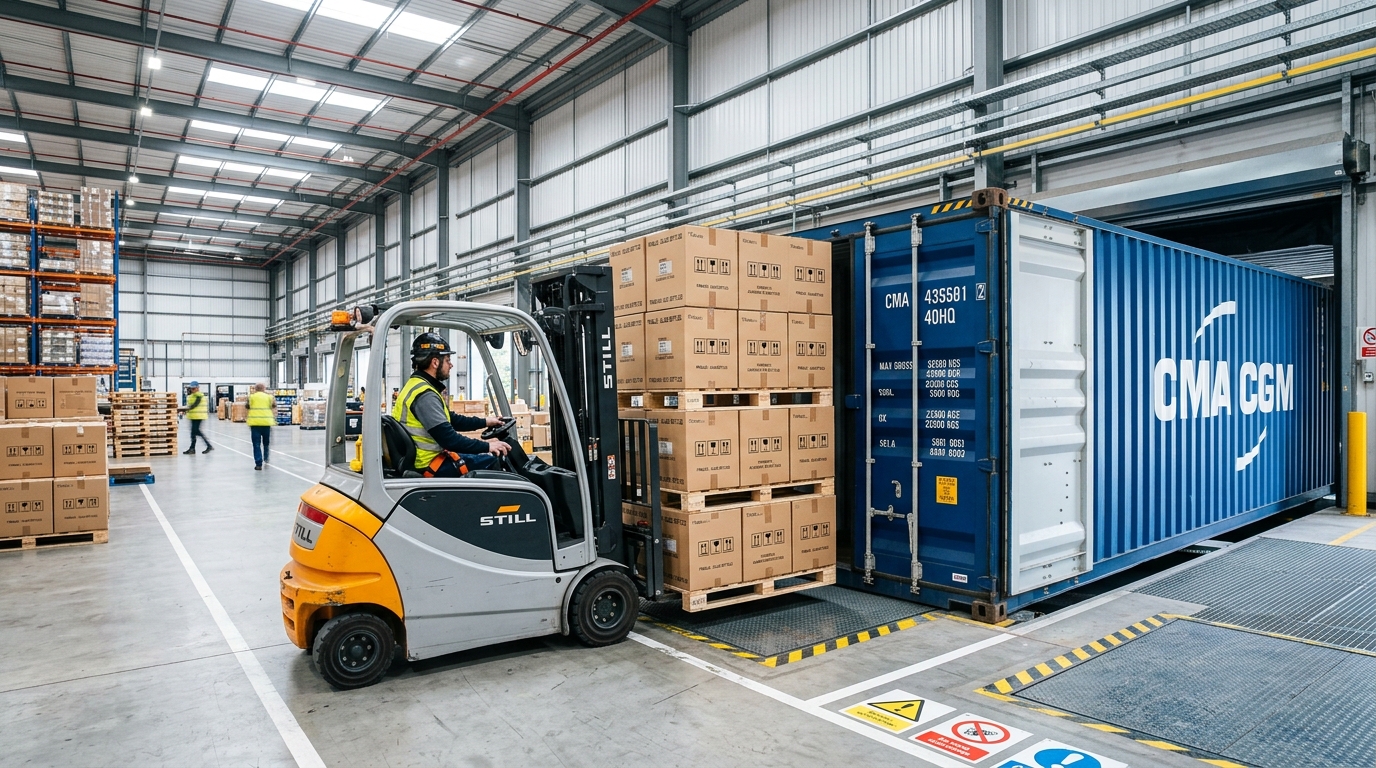
If you are committing to shipping FCL, what size container do you use? A standard 20-foot container (20’GP) is too small; you hit a volume wall immediately. A standard 40-foot container (40’GP) is better, but the 40HQ container (High Cube) is the undisputed champion for glass packaging logistics.
A 40HQ offers an extra foot of vertical height compared to a standard 40-footer (9’6″ vs 8’6″). That single extra foot is transformative. It allows for an entire additional layer of master cartons or taller pallet configurations. Given that you will “cube out” (run out of cubic space) long before you “weigh out” (hit the maximum weight limit) with empty glass bottles, maximizing that cubic volume is critical to driving down unit costs. Shipping a 40HQ usually costs only 10% to 15% more than a standard 40-foot container on the ocean freight side, but it provides roughly 12% to 15% more usable volume. It’s simple, irrefutable math.
| Shipping Method | Typical Volume (CBM) | Handling Touchpoints | Breakage Risk | Cost per Bottle (Est.) |
|---|---|---|---|---|
| LCL (Consolidated) | 5 – 15 CBM | High (6+ touches) | High | $0.15 – $0.35+ |
| FCL (20’GP) | ~28 CBM | Low (2 touches) | Low | $0.08 – $0.12 |
| FCL (40HQ) | ~68 CBM | Low (2 touches) | Lowest | $0.04 – $0.07 |
Loading Strategies: Floor Loaded vs. Palletized
Once you secure your 40HQ, how do you actually put the bottles inside? This is where many buyers, even experienced ones, leave serious money on the table due to a lack of operational alignment between their supplier and their receiving warehouse.
The Palletized Approach: Speed Over Density
Palletized loading means the factory packs the bottles into cartons, stacks the cartons on wooden or plastic pallets, shrink-wraps them securely (often with edge protectors), and uses a forklift to load the pallets into the container.
Pros:
* Rapid Unloading: You can strip a palletized 40HQ container in 30 to 45 minutes with a standard forklift and a single operator at your destination warehouse.
* Lower Warehouse Labor Costs: You save significantly on the manual labor required to unload the container. If your warehouse charges hefty hourly rates for lumpers, this is crucial.
Cons:
* Lost Volume: Pallets themselves take up vertical space (usually 5 to 6 inches per pallet). More importantly, pallets leave gaps. You cannot fill a container wall-to-wall and floor-to-ceiling when using standard pallets because you need clearance to load them. You will invariably lose 15% to 20% of your total container volume. When shipping air, this is a massive penalty.
* Added Cost: Factories charge extra for the pallets themselves (especially treated wood for export) and the labor to build and wrap them.
Floor Loaded: Maximizing Every Square Inch
Floor loaded (or loose loaded) means the factory workers manually stack the cartons of bottles directly onto the wooden floor of the container, building them up like a highly structured Tetris game, floor-to-ceiling, wall-to-wall.
Pros:
* Maximum Density: You utilize close to 100% of the usable space in the container. This drives your per-bottle shipping cost down to the absolute minimum. For a 40HQ shipping 750ml spirit bottles, this can mean several thousand extra bottles per shipment compared to pallets.
* No Pallet Costs: You don’t pay for wooden pallets or the fumigation certificates that accompany them.
Cons:
* Unloading Nightmare: Stripping a floor-loaded 40HQ container requires a dedicated team of workers manually humping boxes for 3 to 6 hours. You will pay for this labor at your destination warehouse, and it is grueling, physically demanding work.
* Warehouse Congestion: If your warehouse isn’t set up for receiving and palletizing loose cartons on the dock, receiving a floor-loaded container can cause massive operational bottlenecks and infuriate your receiving team.
The Verdict: If you are hyper-focused on the cheapest landed cost per unit and have cheap, reliable labor at your destination, floor loaded 40HQ containers are the mathematically superior choice. However, for most mid-sized brands operating in Western markets with high labor costs, palletized loading is the pragmatic choice to save operational headaches upon arrival. You must do the math based on your specific warehouse unloading fees.
Incoterms and Sourcing Hubs: The FOB Qingdao Strategy
Where your bottles originate in China dramatically impacts your inland logistics costs. China is vast, and trucking glass bottles halfway across the country to a port will destroy your logistics budget before the cargo even sees the ocean.
The Glass Manufacturing Belt of Shandong
The vast majority of export-quality glass bottle manufacturing in China—especially for the liquor and spirits sector—is clustered in Shandong Province. Cities like Yuncheng, Heze, and Zibo are the undisputed capitals of glass liquor bottle production, boasting hundreds of furnaces and specialized molding facilities.
Because these factories are concentrated in Shandong, the closest major deep-water port capable of handling massive export volumes is the Port of Qingdao.
Why FOB Qingdao is Mandatory for Glass Buyers
When negotiating your purchase contract, always insist on FOB Qingdao (Free On Board). Under FOB terms, the manufacturer is responsible for all costs and risks up to the point the container is loaded onto the vessel at the Port of Qingdao. This includes the inland trucking from the factory to the port, the export customs clearance, and the terminal handling charges (THC) in China.
If you accept EXW (Ex Works) terms, you are on the hook for hiring a Chinese trucking company to haul a 40HQ from a rural factory in Yuncheng to the port. You don’t want that headache. By standardizing on FOB Qingdao, you shift the local logistics burden to the manufacturer, who has established, high-volume relationships with local truckers and customs brokers. They can execute this inland move cheaper and faster than your forwarder can from thousands of miles away.
If a supplier tries to push FOB Shanghai or FOB Ningbo for glass bottles, be extremely wary. This usually means they are either a trading company located far from the manufacturing base, or they are a factory in a different province, which means higher inland freight costs will be baked into your unit price. Stick to the source: Shandong factories and FOB Qingdao.
Packing, Protection, and Insurance: The Hidden Logistics Costs
The cheapest freight rate on paper is completely useless if half your bottles arrive shattered. Breakage is a logistics cost. It must be factored into your total landed cost calculations.
Strict Inner Packing Requirements
Exporting glass across the Pacific requires robust packaging. A flimsy single-wall corrugated box won’t survive the voyage.
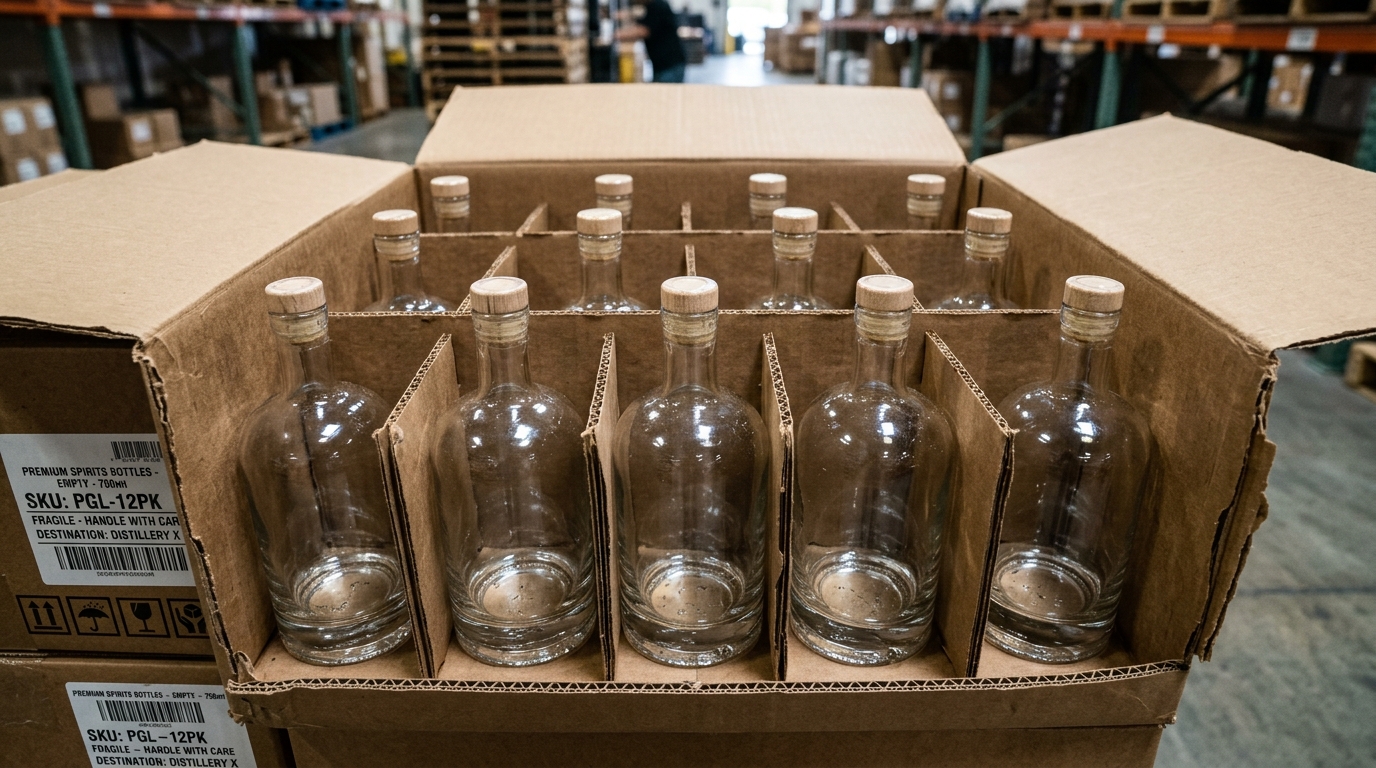
- 5-Ply Corrugated Cartons: Demand minimum 5-ply (double wall) corrugated master cartons. They provide the necessary stacking strength to ensure the bottom layers don’t crush under the weight of a floor-to-ceiling stack.
- Cardboard Dividers: Every single bottle must be separated by a rigid cardboard divider (egg-crating). Bottles cannot touch each other. Glass-on-glass vibration during ocean transit will cause micro-fractures that lead to catastrophic failure later during the bottling process.
- Custom Molding: For ultra-high-end, heavy-base flint glass spirit bottles, consider custom EPS foam or molded pulp inserts, though be aware this will significantly decrease your container density and increase your freight cost per unit.
Moisture Control: Fighting Container Rain
Ocean containers sweat. The severe temperature differentials during a voyage from China to North America or Europe cause condensation, commonly known in the industry as container rain. If cartons get wet, they lose their structural integrity, the stack collapses, and bottles break.
Ensure your supplier lines the floor of the container with cardboard and uses high-capacity desiccant bags hung from the container walls to absorb moisture. This is a non-negotiable standard operating procedure for experienced glass exporters. If your supplier doesn’t do this by default, find a new supplier.
Marine Cargo Insurance: Do Not Skimp
Never ship empty glass bottles without comprehensive marine cargo insurance. The ocean freight industry operates under international conventions that severely limit carrier liability. If a ship encounters a storm and your container is lost overboard, or if the container is dropped during transshipment, the ocean carrier will pay you pennies on the dollar based on weight. And remember, you are shipping lightweight bottles.
Purchase an “All Risk” insurance policy that covers the full CIF value (Cost, Insurance, and Freight) plus 10%. This ensures that if the worst happens, you recover not just the cost of the goods, but the expensive freight you paid to move them.
Conclusion: Stop Bleeding Margin on Inefficient Logistics
The cheapest way to ship empty glass liquor bottles from China isn’t found in a magic bullet, a secret discount code, or haggling over pennies on a spot rate. This is achieved through rigorous, disciplined logistics management.
First, you must understand the physics of your cargo—that you are shipping volume, not weight. Second, unequivocally reject LCL in favor of 40HQ containers. It means doing the hard math on floor loaded vs palletized to see what your specific receiving warehouse can optimally handle. Finally, force your supply chain through the most efficient geographic nodes by demanding FOB Qingdao terms from factories located squarely in the Shandong glass belt.
If you fail to optimize these variables, your competitors will undercut you on the shelf simply because their landed costs are structurally 10% to 15% lower than yours. Logistics for glass packaging is a brutal game of inches, and every cubic meter counts.
Stop playing games with unproven suppliers and middlemen trading companies that don’t understand the physical realities of glass export logistics. Partner with a manufacturer that builds container optimization into the structural design of the bottle itself and understands the downstream impact of their packing methods.
Ready to Elevate Your Brand?
At Jinpeng Glass, we don’t just manufacture premium flint glass liquor bottles; we engineer end-to-end logistics solutions. With decades of experience exporting high-volume orders to distilleries globally, we handle the complexities of FOB Qingdao shipments natively, ensure flawless export packaging designed to survive the Pacific, and guarantee your bottles arrive intact and ready for the filling line. Contact Jinpeng Glass today for wholesale manufacturing and a genuinely hassle-free, cost-optimized shipping strategy that protects your margins.


