

[Expert Insights] Recently, the global spirits packaging industry has observed a significant surge in demand for fractional packaging, specifically within the agave spirits sector. Historically, brands reserved these units exclusively for promotional sampling. However, mini tequila bottles have now evolved into a highly profitable, distinct retail category. Moreover, premiumization, airline procurement, and consumer demand drive this rapid transition. Therefore, optimizing the supply chain for mini tequila bottles remains critical for market expansion. This technical guide outlines the manufacturing and procurement logistics for 50ml glass packaging.
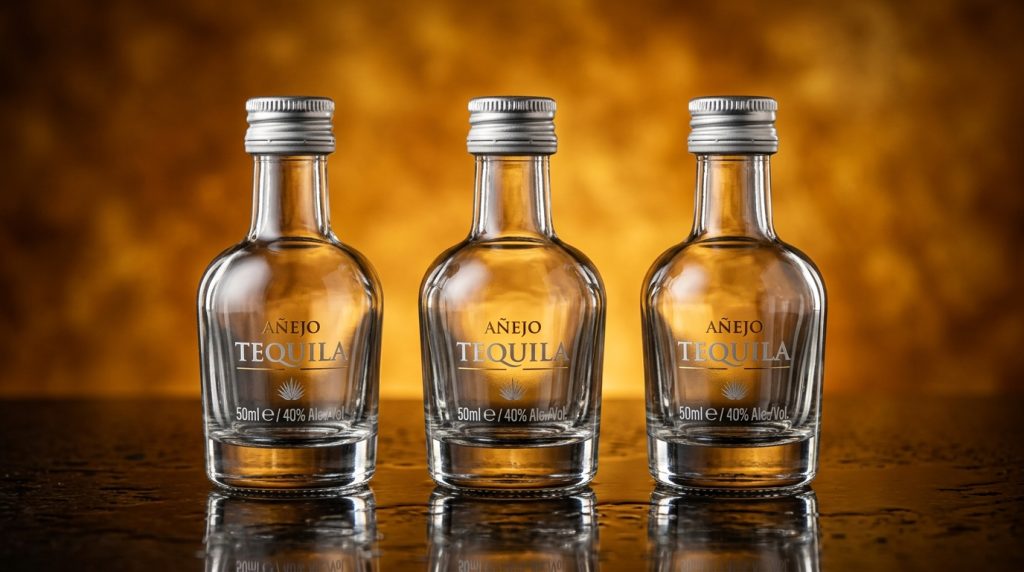
1. The Market Demand for Small Tequila Bottles
First and foremost, the utility of small tequila bottles extends far beyond novelty retail. For instance, in the global hospitality and travel sectors, aviation authorities heavily regulate these fractional containers—colloquially known as tequila nips or airplane bottles of tequila.
Consequently, the standardized format allows beverage brands to distribute a tequila shooters pack for retail tasting without requiring the consumer to commit to a full 750ml purchase. Furthermore, the international appeal of agave spirits has sharply increased demand for botellas de tequila pequeñas across Latin American and European distribution networks. Ultimately, manufacturers must engineer these little tequila bottles to maintain the exact aesthetic integrity and brand identity of their full-sized counterparts.
2. Standard 50ml Mini Tequila Bottles vs. Custom Molds
To begin with, when sourcing miniature packaging, manufacturers must quickly decide between catalog designs and proprietary molds. Globally, the beverage market uniformly recognizes the standard fractional format as 50ml tequila bottles (or simply tequila 50ml).
Interestingly, engineers designing custom mini tequila bottles 50ml must use the exact same thermal tooling tolerances required for the smallest bottle of whiskey or standard 50ml vodka bottles. Thus, to evaluate the logistical impacts of mold selection, consider the following technical comparison:
Quick Comparison: Standard vs. Custom 50ml Packaging
| Specification | Standard 50ml Catalog Mold | Proprietary Custom Mold |
|---|---|---|
| Tooling Expense | Zero (Pre-engineered by factory) | High (Requires CAD and physical molds) |
| Brand Differentiation | Low (Generic cylindrical or flask) | Maximum (Scaled-down replica of 750ml) |
| Production Speed | Rapid inventory deployment | Extended sampling and revision phases |
| Procurement Scale | Viable for smaller craft distilleries | Requires high-volume financial commitment |
3. Material Considerations for Mini Tequila Shots
Importantly, the physical composition of the packaging used for mini tequila shots heavily influences both freight logistics and perceived product value. For example, while PET (polyethylene terephthalate) plastic offers significant weight reductions for aviation catering, high-end brands exclusively utilize extra-flint glass. Indeed, they do this to prevent chemical leaching and oxidation.
Because of this, ensuring the glass is chemically inert is paramount, especially when scaling down a luxury añejo profile into a tequila mini format. Additionally, factories must precision-engineer the glass neck finish to accept standard 18mm aluminum roll-on pilfer-proof (ROPP) closures. As a result, the small tequila shots remain hermetically sealed during transit.
4. How to Procure Mini Tequila Bottles Bulk
Similarly, efficiently sourcing mini tequila bottles bulk requires identifying manufacturing facilities capable of high-speed, small-vessel forming. Unlike standard 750ml formats, miniature glass forming demands specialized IS (Individual Section) machines. In fact, these machines must operate at increased cycle speeds to maintain structural integrity.
For instance, brands operating heavily in Hispanic markets can eliminate trading company markups by sourcing botellas mini de tequila directly from specialized primary glass manufacturers. Similar to the procurement strategy outlined in our Glass Bottled Water Sourcing Guide, procurement officers must always request physical samples. Consequently, they can conduct closure torque and leakage testing prior to mass production.
5. Frequently Asked Questions (FAQ)
How much is a small bottle of tequila to manufacture? Generally, the B2B manufacturing cost of empty 50ml glass vessels typically ranges from 0.15to0.35 per unit. Ultimately, glass weight, custom embossing requirements, and total order volume determine this variance.
What factors influence the tequila small bottle price at retail? First, liquid quality (e.g., 100% Blue Weber Agave, Reposado, or Añejo) plays a major role. In addition, specific taxation on fractional spirits and the premiumization of the glass packaging itself heavily dictate retail pricing.
6. Submitting an RFQ for 50ml Packaging
To initiate a procurement contract, buyers must first submit a formalized Request for Quote (RFQ). Specifically, the 50ml capacity complies exactly with international aviation security regulations, such as the TSA 3-1-1 liquids rule. As a result, it remains the undisputed global standard for travel-sized spirits.
Therefore, ensure your RFQ documentation specifies:
- Volumetric Capacity: 50ml (1.7 oz)
- Neck Finish Specification: (e.g., 18mm ROPP or 18mm Screw Thread)
- Material Preference: (Premium Flint Glass vs. Standard Glass)
- Projected Annual Volume: (Crucial for calculating bulk discount tiers)
👉 Click Here to Consult with Our Packaging Experts for Your Next Project


