

In today’s rapidly evolving consumer market, product packaging is often the “first touchpoint” of communication between a brand and its consumers. Whether it’s a high-end perfume on a department store counter or a vintage spirit displayed in a cellar, glass bottles have consistently held an irreplaceable position thanks to their crystal-clear texture, excellent chemical stability, and high environmental recycling value. However, how does a pristine bare bottle transform into a work of art that carries a brand’s story? One of the most crucial and texture-enhancing surface treatment techniques is glass bottle silk-screen printing.
Today, we will take you on a professional deep dive to deconstruct this packaging aesthetic that perfectly marries traditional craftsmanship with modern intelligent manufacturing. If you are currently seeking the perfect packaging solution for your upcoming new product, feel free to explore our customized glass packaging solutions.
What is Glass Bottle Silk-Screen Printing? Why is it Timeless?
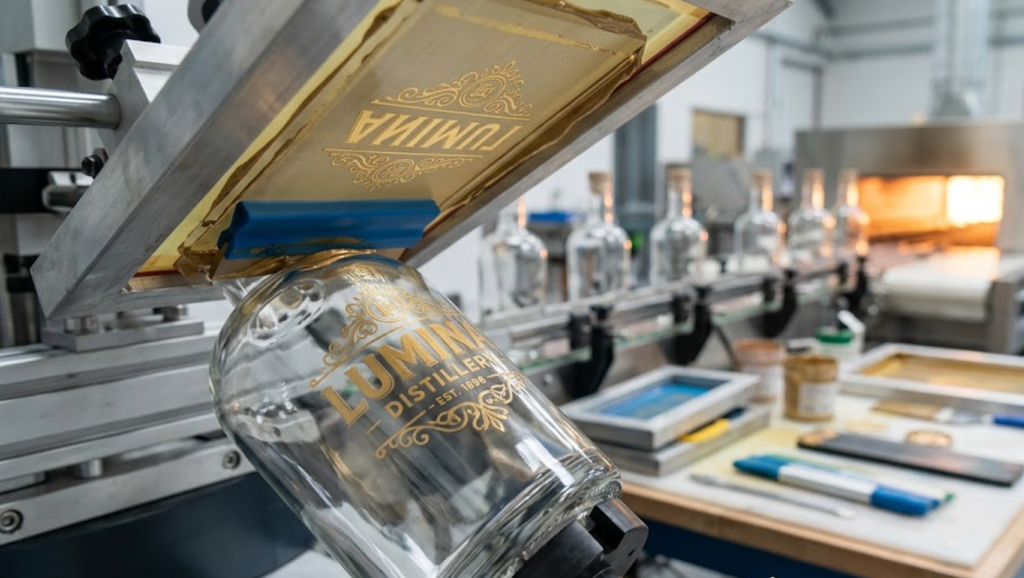
The history of screen printing dates back thousands of years, but its flawless application to curved glass packaging is a masterpiece of modern industry. Simply put, glass bottle silk-screen printing is a “stencil printing” technique. It utilizes a specialized mesh (usually made of nylon or stainless steel) stretched tightly over a frame. Through a photosensitive platemaking process, the areas that do not require printing are blocked off, leaving only the mesh holes in the graphic and text areas open. During printing, a squeegee presses the ink with specific pressure and speed, forcing it through these microscopic holes to adhere precisely to the glass bottle.
Compared to traditional paper stickers or plastic labels, the silk-screen process offers a revolutionary advantage. It completely eliminates the abrupt edges of a label, achieving true “seamless integration.” The design appears as if it has grown organically from within the glass itself, presenting exceptional visual purity. For readers who want to delve deeper into the underlying physical principles and historical evolution of screen printing, you can refer to the detailed Wikipedia article on Screen Printing.
Unveiling the “Silk-Screen Journey” of a Glass Bottle
Leaving a permanent, crisp, and vibrantly colored design on a smooth, curved glass bottle is no easy feat. It requires a series of rigorous and highly standardized procedures:
1. Preliminary Graphic Design and Film Output
Everything starts with design. Designers create high-precision vector graphics tailored to the curvature of the bottle and the brand’s requirements. Since most glass bottles are cylindrical or irregularly shaped, the design must account for deformation compensation when unwrapped onto a curved surface to avoid visual distortion after printing. Once confirmed, the graphics are output as high-contrast photographic film, which serves as the “mold” for subsequent platemaking.
2. Precision Screen Making and Exposure
Workers apply a uniform layer of photosensitive emulsion onto the highly tensioned mesh and dry it in a temperature-controlled darkroom. The photographic film is then pressed tightly against the screen and placed into a UV exposure machine. Under the UV light, the emulsion not blocked by the film’s dark areas cross-links and hardens, while the unexposed emulsion in the graphic areas remains water-soluble. After precise washing with a high-pressure water gun, the mesh holes in the graphic areas are completely cleared, giving birth to a high-precision printing screen.
3. Exclusive Ink Preparation: High-Temperature vs. Low-Temperature UV
The choice of ink in this stage is critical. Glass silk-screening is primarily divided into two main categories:
- High-Temperature Glass Inks: The core ingredients include inorganic pigments and low-melting-point glass frit (powder). At room temperature, this ink merely adheres to the surface; it only truly fuses after high-temperature baking. Its advantage lies in its extreme durability and resistance to acids and alkalis, making it the absolute standard for premium liquor and perfume bottles.
- Low-Temperature UV Inks: These contain photoinitiators and are cured instantly via a polymerization reaction when exposed to UV light immediately after printing (within seconds). The advantages are energy efficiency, environmental friendliness, and richer color expression (especially vibrant, bright colors). Since it doesn’t require extreme heat, it is highly suitable for thin-walled or special glass materials that cannot withstand high thermal shock.
Experienced colorists strictly follow the Pantone Matching System to formulate these inks precisely, ensuring zero color deviation for the brand’s visual identity.
4. Fully Automated Printing
Modern glass bottle screen printing predominantly utilizes high-precision, fully automatic cylindrical screen printing machines. The glass bottle is securely clamped into a fixture by a robotic arm and rotates at a constant speed, while the squeegee moves horizontally above it with consistent pressure (usually several kilograms) and speed. In this instant, the rich ink is pressed through the mesh and fully transferred onto the curved glass. For multi-color registration, the equipment relies on advanced photoelectric sensors for visual positioning; any millimeter-level deviation is automatically rejected by the system.
5. Rebirth in Fire: High-Temperature Baking
This is the “ultimate battle” that determines the quality of high-temperature silk-screening. The printed glass bottles must be sent into a caterpillar-style lehr oven stretching tens of meters long. During a slow progression lasting two to three hours, the temperature inside the oven gradually climbs to between 500°C and 600°C. At these extreme temperatures, the microscopic glass powder within the ink completely melts and physically fuses with the glazed layer on the glass bottle’s surface. After a slow cooling process, the design becomes one with the bottle, ensuring it never peels or scratches off.
6. Rigorous Quality Inspection
Before packaging and warehousing, the finished products must undergo destructive quality sampling. This includes: Cross-hatch testing (scoring a grid over the print with a sharp blade and applying strong tape to test adhesion); Abrasion resistance testing (simulating high-frequency collisions during long-distance transit); and Solvent immersion testing (especially crucial for perfume bottles to ensure high-concentration alcohol does not dissolve the ink layer). Only glass bottles that pass these grueling tests are approved to leave the factory.
Why Do Top Brands Prefer Silk-Screen Printing?
- Indestructible Durability: The screen-printed designs after high-temperature baking possess exceptional scratch resistance. Whether it’s champagne chilling in an ice bucket or skincare products sitting in a humid bathroom for extended periods, silk-screened designs will never wrinkle, peel, or fade like standard stickers.
- Fascinating 3D Tactile Sensation: The ink layer in screen printing is significantly thicker than standard printing. By gently running your fingers over the bottle, you can clearly feel the slightly raised, embossed texture of the text and patterns. This tangible physical feedback significantly elevates the product’s sense of luxury.
- 360-Degree Panoramic Visual Display: It completely shatters the physical limitations of label sizes and shapes. Brands can print panoramic, wrap-around designs on the bottle without blind spots, showcasing powerful artistic tension against the ultimate backdrop of transparent glass.
Conclusion
From a humble screen mesh to the tempering of hundreds of degrees of heat, the glass bottle silk-screen process is not merely a rigorous industrial technique; it is the art of branding a company’s soul onto a physical medium. For brands pursuing ultimate quality and consumer experience, choosing silk-screen printing means choosing an uncompromising commitment to product details. We hope this article has demystified the silk-screen process for you and provided valuable inspiration for crafting the packaging of your next blockbuster product.


