

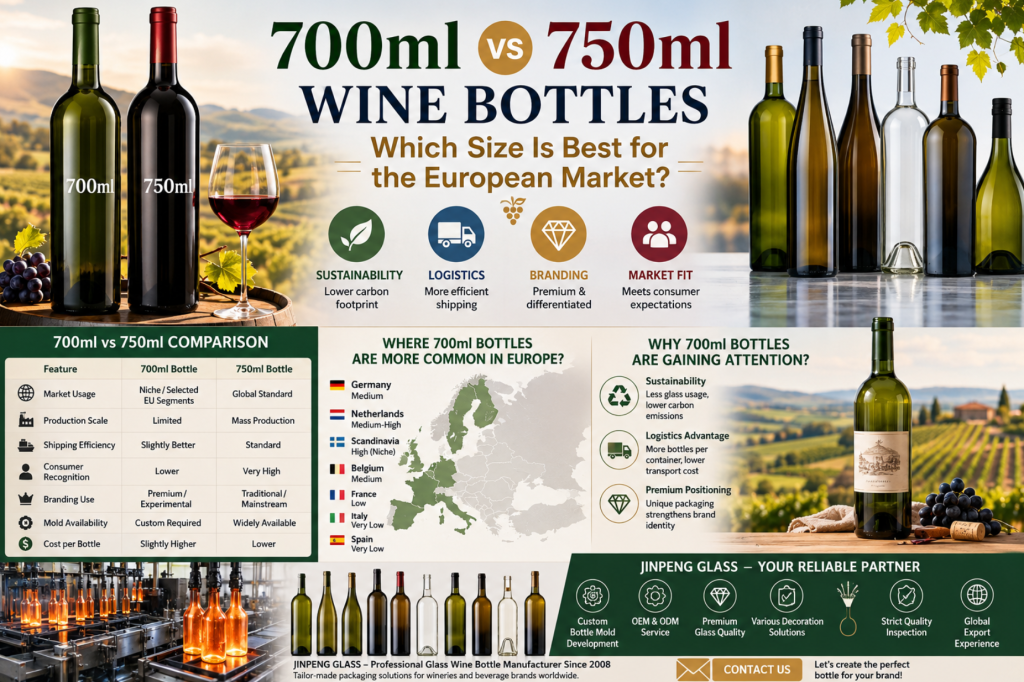
If you work in wine packaging or export wine bottles to Europe, you’ve probably noticed a growing discussion around bottle sizes.
Most people assume wine bottles are always 750ml, and for the global market, that is still largely true. But in some European segments, especially niche brands and specific product positioning, 700ml bottles are starting to appear more frequently.
At Jinpeng Glass, we manufacture glass wine bottles for wineries, importers, and beverage brands across Europe, South America, and North America. One of the most common questions we hear is simple but important:
“Should we use 700ml or 750ml wine bottles for Europe?”
The answer is not about a single standard. It depends on regulation, branding strategy, logistics, and market positioning.
Let’s break it down clearly.
Why 750ml Became the Global Wine Standard
Before discussing 700ml, we need to understand why 750ml dominates the global wine industry.
The 750ml format became widely adopted due to historical trade alignment between Europe and international markets. Over time, it became the most efficient standard for:
- Bottling line compatibility
- Export consistency
- Case packing (typically 6 or 12 bottles)
- Retail shelf standardization
- Consumer expectation
Today, most wine-producing countries still rely on 750ml:
- France
- Italy
- Spain
- United States
- Chile
- Australia
- Argentina
From a manufacturing perspective, 750ml bottles are also easier to produce at scale because:
- Mold systems are standardized
- Filling equipment is globally compatible
- Logistics chains are optimized around this volume
At Jinpeng Glass, more than 80% of wine bottle production still follows the 750ml format, especially for Bordeaux and Burgundy-style bottles.
Why Are Some European Wine Bottles Now 700ml?
Now we come to the real question.
The rise of 700ml wine bottles in parts of Europe is not a replacement of 750ml, but rather a response to specific market pressures.
There are three main drivers.
1. Packaging Flexibility in the EU Market
European packaging rules allow certain flexibility in nominal volumes for alcoholic beverages, especially in:
- Specialty wine products
- Gift packaging
- Limited editions
- Cross-category beverages (wine-based drinks, cocktails)
This flexibility has allowed brands to experiment with alternative bottle sizes, including 700ml.
However, it is important to clarify:
700ml is not a universal EU wine standard. It is used selectively.
2. Sustainability Pressure on Glass Packaging
Europe is one of the most sustainability-driven packaging markets in the world.
A slightly smaller bottle can reduce:
- Glass raw material consumption
- Furnace energy usage
- CO₂ emissions in production
- Shipping weight per container
Even a 50ml difference becomes significant when multiplied across millions of bottles.
From a manufacturing perspective, lighter packaging strategies are becoming a key requirement from European buyers.
At Jinpeng Glass, we increasingly receive requests for:
- Lightweight wine bottle designs
- Reduced base thickness options
- Optimized bottle geometry for freight efficiency
3. Premium Branding and Market Differentiation
Not all changes are regulatory or environmental—some are purely marketing-driven.
Wine brands in competitive European retail environments often need:
- Visual differentiation
- Shelf impact
- Premium perception
- Limited-edition storytelling
A 700ml bottle can subtly signal:
- “Special release” positioning
- Non-standard craftsmanship
- Boutique wine identity
This is especially common in:
- Germany
- Netherlands
- Scandinavia
- Belgium niche wine markets
700ml vs 750ml Wine Bottles Comparison
Below is a practical comparison from a manufacturing and export perspective.
| Feature | 700ml Wine Bottle | 750ml Wine Bottle |
|---|---|---|
| Market usage | Niche / selected EU segments | Global standard |
| Production scale | Limited | Mass production |
| Mold availability | Custom required | Standard molds widely available |
| Shipping efficiency | Slightly better | Standard |
| Consumer recognition | Lower | Very high |
| Retail acceptance | Region-specific | Universal |
| Branding use | Premium / experimental | Traditional / mainstream |
| Cost per bottle | Slightly higher | Lower due to scale |
Key Insight from Manufacturing Side
From a factory perspective, the biggest difference is not volume—it is system compatibility.
Switching from 750ml to 700ml often requires:
- New mold development
- Filling line recalibration
- Packaging redesign (cartons, pallets)
- Compliance verification per market
This is why most wineries do not fully switch—they test 700ml in limited product lines first.
Part 2: Regulations, Sustainability, and Real Market Drivers Behind 700ml vs 750ml Wine Bottles
EU Regulations: Is 700ml Even a Standard?
A common misunderstanding is that the European Union officially promotes 700ml wine bottles as a standard alternative to 750ml.
This is not correct.
In reality, the EU regulatory framework focuses more on:
- Label accuracy (nominal volume declaration)
- Consumer protection
- Packaging compliance
- Alcohol taxation classification
The EU does not enforce a single mandatory wine bottle size for still wine.
Instead, it allows a range of nominal volumes under the general packaging directive system, which is why you may see:
- 187ml mini bottles
- 375ml half bottles
- 500ml niche formats
- 750ml standard bottles
- 1L bulk bottles
- And occasionally 700ml specialty bottles
From a manufacturing perspective at Jinpeng Glass, the key point is:
700ml is a permitted format, not a regulated standard.
That distinction is important for exporters, because compliance risk is not about size—it is about labeling accuracy and market acceptance.
Sustainability: The Real Engine Behind Packaging Changes
If there is one factor reshaping glass packaging in Europe more than anything else, it is sustainability pressure.
European buyers—especially importers and supermarket chains—are actively evaluating packaging based on:
- Carbon footprint per bottle
- Glass weight reduction
- Recyclability performance
- Transport efficiency
Even small changes matter.
Example comparison:
| Factor | 750ml Bottle | 700ml Bottle |
|---|---|---|
| Glass weight (avg) | 420–650g | 380–600g |
| CO₂ per unit | Higher | Lower |
| Freight efficiency | Standard | Slightly improved |
| Annual impact (1M bottles) | Baseline | Noticeable reduction |
For large-scale wineries, even a 5–8% packaging weight reduction can translate into:
- Lower freight costs
- Better ESG compliance scores
- Easier approval from retail chains
At Jinpeng Glass, we often see European clients requesting:
- Lightweight bottle redesigns
- Thin-wall flint glass options
- Optimized base structure without losing stability
However, we also caution clients:
Too much weight reduction can damage perceived premium value.
So it becomes a balancing act between sustainability and brand positioning.
Shipping & Logistics: Where Small Differences Become Big Costs
Wine bottles are a classic “volume logistics product”.
A small change in glass weight or capacity can scale significantly across containers.
Let’s break it down.
Container efficiency example (simplified):
| Metric | 750ml Bottles | 700ml Bottles |
|---|---|---|
| Bottles per 20ft container | ~9,000–10,000 | ~9,500–10,500 |
| Total glass weight | Higher | Lower |
| Breakage risk (heavy load) | Standard | Slightly reduced |
| Cost efficiency | Baseline | Slight improvement |
But here is the key insight most buyers miss:
The shipping savings from 700ml are real, but not dramatic enough to justify switching formats alone.
From a factory point of view, logistics benefits are secondary—not the main reason for adoption.
European Market Adoption: Where 700ml Appears
700ml wine bottles are not evenly distributed across Europe.
Their usage is highly segmented.
Market overview:
| Country/Region | Adoption Level | Typical Use Case |
|---|---|---|
| Germany | Medium | Eco-focused brands, boutique wines |
| Netherlands | Medium-High | Retail innovation products |
| Scandinavia (SE/DK/NO/FI) | High (niche) | Sustainability-driven packaging |
| Belgium | Medium | Specialty import wines |
| France | Low | Traditional 750ml dominance |
| Italy | Very Low | Heritage-driven packaging |
| Spain | Very Low | Export standard 750ml |
Key insight:
- Southern Europe = tradition-driven (750ml dominant)
- Northern Europe = innovation + sustainability-driven (700ml experiments)
This explains why exporters often see mixed signals when researching “European bottle sizes.”
Manufacturer Perspective: What We See at Jinpeng Glass
From our production lines, the pattern is very clear.
Most clients fall into three categories:
1. Traditional wineries (80%+)
They continue using:
- 750ml Bordeaux bottles
- 750ml Burgundy bottles
- Standard flint or antique green glass
Reason: global distribution consistency.
2. Premium niche brands (15%)
They explore:
- 700ml limited editions
- Heavy base artistic bottles
- Embossed custom molds
Reason: brand differentiation.
3. Experimental / sustainability-driven buyers (5%)
They request:
- Lightweight 700ml bottles
- Reduced glass thickness
- Low-carbon packaging design
Reason: ESG targets and retail compliance.
Important Reality Check (Industry Truth)
Many discussions online suggest:
“Europe is shifting to 700ml wine bottles.”
From a manufacturing and export reality perspective, this is overstated.
A more accurate statement is:
Europe is diversifying wine packaging formats, not replacing 750ml.
This is a critical distinction for exporters.
Part 3: How to Choose Between 700ml and 750ml Wine Bottles (and What Actually Matters for Wineries)
How Wineries Should Decide: 700ml vs 750ml
At this point, one thing should already be clear:
The decision is not about which size is “better”, but which size fits your market strategy.
From a manufacturing perspective at Jinpeng Glass, we usually advise clients to evaluate based on four practical factors:
1. Target Market Expectations
If your wine is exported globally, especially to:
- USA
- France
- Italy
- Spain
- South America
Then 750ml is still the safest and most accepted format.
If your target is more niche European retail channels (especially Northern Europe), then testing 700ml may make sense.
2. Brand Positioning
| Brand Type | Recommended Bottle |
|---|---|
| Mass market wine | 750ml |
| Heritage winery | 750ml |
| Premium boutique label | 700ml (limited series) |
| Eco-focused brand | 700ml or lightweight 750ml |
A key insight many brands miss:
Bottle size is part of branding, not just packaging.
3. Production System Compatibility
Switching to 700ml is not just a design change.
It may require:
- New mold development
- Filling line recalibration
- Carton redesign
- Pallet optimization
- Compliance testing per country
At Jinpeng Glass, we always evaluate whether the change is operationally worth it before recommending production.
4. Cost vs Value Balance
Many buyers assume 700ml automatically reduces cost.
In reality:
- Glass savings are small
- Mold cost increases
- Setup complexity increases
- Logistics savings are moderate
So the real question becomes:
Does the marketing value of 700ml justify the operational complexity?
For most mainstream wineries, the answer is still no.
Why Jinpeng Glass Is a Reliable Wine Bottle Manufacturer for Europe
At Jinpeng Glass, we are not just producing bottles—we are helping beverage brands design packaging that fits real market conditions.
Our factory supports both standard and custom wine bottle production, including:
Manufacturing Capabilities
- 750ml Bordeaux wine bottles
- 750ml Burgundy wine bottles
- 700ml custom wine bottles
- Extra flint (super clear glass) bottles
- Antique green and emerald green glass
- Heavy base premium bottles
- Lightweight eco glass bottles
- Embossed logo bottles
- Silk-screen printing
- Frosted and sprayed finishing
- Hot stamping & decal decoration
- Custom mold development (OEM/ODM)
Production Advantages
- Factory direct manufacturing
- 15+ years glass production experience
- Strict quality inspection before shipment
- Stable mass production capability
- Export experience to Europe, America, and Asia
- One-stop packaging solution
Frequently Asked Questions (FAQ)
Is 700ml replacing 750ml wine bottles in Europe?
No. 750ml remains the global standard. 700ml is used only in niche or experimental packaging.
Can I export 700ml wine bottles to Europe?
Yes, but you must confirm labeling and market acceptance with your distributor.
Which bottle size is better for premium wine?
Both can be premium. 750ml is traditional; 700ml is more experimental and brand-driven.
Does 700ml reduce shipping cost significantly?
Not significantly. It provides minor savings but is not the main reason brands switch.
Can Jinpeng Glass produce custom wine bottle molds?
Yes. We specialize in OEM custom glass bottle mold development for wineries and beverage brands.
What is the most popular wine bottle size globally?
750ml is still the dominant global standard.
Do European supermarkets prefer 700ml?
Only in specific regions and niche product lines. Most still prefer 750ml.
What glass types are available?
We produce flint, super flint, antique green, emerald green, and amber glass bottles.


