

A deep dive into why do whisky bottles have an indent in the base. Explore the advanced thermal physics, structural mechanics, fluid dynamics, and premium aesthetics that define modern whisky bottle anatomy.
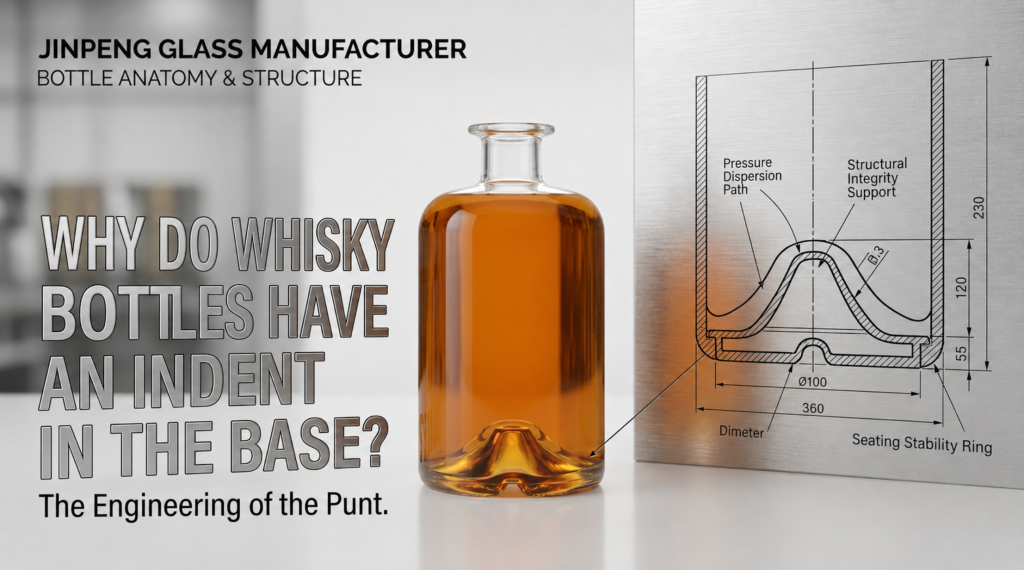
When you hold an exceptional bottle of single malt Scotch, aged bourbon, or craft rye, your hand instinctively gravitates toward the deep, smooth curve molded into the bottom of the glass. In premium spirits circles, sommelier culture, and the global container manufacturing industry, this distinctive structural hollow is far from an accidental aesthetic feature. It is professionally known as a “punt.”
While modern consumers often perceive it purely as a visual marker of luxury, high-end branding, and artisan heritage, the integration of a punt into contemporary whisky bottle design represents a masterful intersection of historical craftsmanship, structural physics, and brand identity. If you have ever looked at a crystal decanter or custom commercial spirit packaging and wondered, why do whisky bottles have an indent in the base?, the comprehensive answer lies within the highly complex, fascinating world of heavy-gauge industrial glass engineering. Understanding this feature requires peeling back the layers of how a bottle interacts with automated filling lines, temperature variances, fluid dynamics, and retail shelf ergonomics.
The Structural Physics Behind the Punt: Managing Mechanical Stress
The primary reason for integrating a heavy indent into a spirit bottle comes down to the fundamental laws of geometry and mechanical pressure management. In the comprehensive structural study of whisky bottle anatomy, the base of any glass container is historically the most vulnerable point of failure when subjected to physical shock, internal kinetic force, or external load pressure.
When high-proof spirits are filled, hermetically sealed, and subsequently shipped across diverse global distribution networks, they undergo subtle yet constant thermal expansions and contractions. For example, transit through changing climates—from freezing cargo hulls to sweltering shipping containers—causes the liquid volume inside to fluctuate. A flat-bottomed glass container distributes physical shock and internal hydraulic pressure directly across a single, uniform horizontal plane. This creates catastrophic stress concentration points along the outer bottom edge, drastically increasing the risk of structural fractures during minor impacts.
By curving the base inward to create a geometric dome structure, the laws of physics redirect vertical pressure and downward gravitational force outward toward the thicker, reinforced heel of the bottle. This geometric redistribution dramatically enhances the container’s structural integrity. Consequently, it allows the glass to easily withstand the high-speed impacts of automated conveyor lines, industrial palletization, and the turbulent vibrations of international maritime shipping.
Technical Comparison: Flat Base vs. Punted Base Anatomy
To better understand how precise whisky bottle design impacts product safety, shelf presence, and manufacturing performance, the engineering table below highlights the critical benchmarks between a standard flat-bottom glass layout and a professionally engineered punted base.
| Structural & Commercial Component | Flat Base Design | Punted Base Architecture (Indent) |
| Stress Concentration & Shock Distribution | Concentrated on a single flat horizontal plane; higher crack and fracture risk under sudden impact. | Dispersed outwardly and evenly toward the reinforced outer heel and thicker glass base walls. |
| Thermal Expansion & Pressure Tolerance | Low; vulnerable to structural failure from high-proof internal volume pressure shifts. | High; geometric dome naturally absorbs and neutralizes inner liquid volumetric pressure changes. |
| Shelf Stability (“Seating Accuracy”) | Prone to wobbling, tilting, or vibrating if microscopic cooling imperfections occur during manufacturing. | Rests exclusively on an engineered perimeter seating ring, isolating imperfections away from surfaces. |
| Optical Refraction & Liquid Presentation | Uniform and flat; limits ambient light play and fails to showcase the depth of the liquid’s color. | Acts as an internal structural prism, reflecting environmental light back upward to highlight amber tones. |
| Ergonomic Grip & Sommelier Pouring | Requires awkward two-handed pouring techniques or neck gripping, which obscures the brand label. | Provides a natural, traditional thumb anchor point for steady, elegant, and professional pouring. |
Perfecting the Seating: Why Flat Glass Isn’t Truly Flat
From a high-volume manufacturing standpoint, achieving an absolute, microscopically level flat surface on molten glass is an exceptionally difficult engineering challenge. As glass cools down from extreme furnace temperatures exceeding 1,000°C, slight volumetric shrinkages and unevenness naturally form due to rapid, unpredictable thermal shifts within the molding equipment.
If a commercial spirits bottle were engineered with a completely flat base, even a sub-millimeter protrusion or cooling blemish at the dead center would cause the entire bottle to wobble, tilt, or unsteadily vibrate on solid surfaces. A unstable bottle not only risks tipping over on retail shelves but can also scratch high-end bar tops and cause alignment errors on automated labeling lines. By embedding an intentional, precise indent, industrial designers ensure that the bottle rests exclusively on its outer perimeter. This creates an incredibly stable, unyielding “seating ring” that keeps the bottle perfectly upright, balanced, and immovably secure on commercial shelves and residential liquor cabinets alike. This small adjustment plays a vital, foundational role in stabilizing the entire whisky bottle anatomy.
The Aesthetics and Optical Brilliance of Modern Whisky Bottle Design
Beyond the clear structural and mechanical safety benefits, premium spirit branding relies heavily on multi-sensory visual storytelling. The internal curvature of a heavy glass bottle interacts uniquely with light. When amber-hued liquid fills a custom-engineered glass bottle, the internal punt effectively acts as a dynamic optical prism. It captures ambient environmental light, reflecting it back upward and outward through the layers of the liquid. This process accentuates the natural golden, copper, or deep mahogany tones of the aged spirit, giving the product an illuminated, premium aura on a crowded back-bar shelf.
Furthermore, this architectural depth provides a premium, heavy, and satisfying tactile weight distribution. Modern consumers subconsciously associate heavier, structurally complex glass with luxury, heritage, and elite quality. From a practical hospitality standpoint, bartenders and spirits connoisseurs value a bottle that feels substantial and ergonomic. The base indent offers a natural structural anchor point for the thumb when pouring, a traditional gesture utilized in high-end hospitality environments world-wide. This allows the server to pour smoothly without blocking the distillery’s front label with their hand, thereby maintaining brand visibility during every single pour.
Sourcing Excellence in Custom Glass Architecture
For expanding distillery brands, craft spirit entrepreneurs, and global liquor distributors, selecting a manufacturing partner that balances historical authenticity with rigorous modern mechanical tolerance standards is paramount. This is exactly where precision engineering bridges the gap between creative design concepts and high-volume commercial realities.
Leading international industrial manufacturers, such as Jinpeng Glass Manufacturer, specialize in executing precise, high-density custom molds that perfectly preserve these essential design dynamics. Whether your brand is looking to engineer a traditional, heavy-base Nordic bottle, a classic American bourbon container, or a bespoke, intricate geometric crystal pattern, understanding the exact physics of why do whisky bottles have an indent in the base ensures your end product performs flawlessly from the high-speed bottling line to the consumer’s glass.
Advanced production facilities at Jinpeng Glass Manufacturer utilize state-of-the-art thermal imaging, automated laser pressure testing, and precision mold technology to guarantee every single punt is structurally sound, visually immaculate, and ready for global distribution.
To explore how custom physical specifications, glass thickness, and precise base engineering can dramatically elevate your brand’s shelf presence and reduce transit breakage, you can review the international regulatory frameworks and standards for industrial container glass properties established by the Glass Alliance Europe. Ultimately, mastering the deep nuances of whisky bottle anatomy isn’t just about looking premium on a store shelf—it’s about engineering your liquid history to last for generations.


